PEJABAT TRANSFORMASI PERANCANGAN STRATEGIK & RISIKO
UNIVERSITI MALAYSIA TERENGGANU

SETARA >> Criteria 1: General

Kemaskini 22 Disember 2025

SECTION 1: GENERAL

CRITERIA 1.1: STUDENT QUALITY & DIVERSITY


No Item Glossary/Definition/Calculation Formula
1.1.1 Percentage of local students intake for Bachelor programme with CGPA ≥ 3.0 or equivalent as of 31st  Dec in the year of evaluation. no. of local students intake for Bachelor programme with CGPA ≥ 3.00 or equivalent as of 31st Dec in the year of evaluation
———————————————————-    x 100
total no. of local students intake for Bachelor programme as of 31st  Dec in the year of evaluation
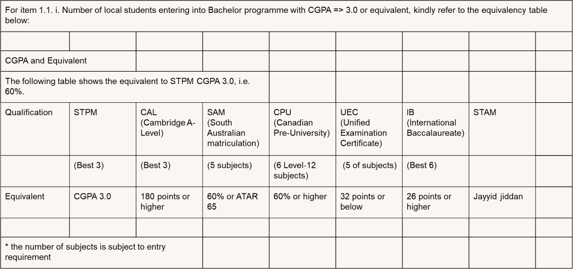
●    CGPA is taken from the results of matriculation, foundation,    and    STPM,    Diploma    or    their equivalent  (e.g.,  A  Level  (CAL),  SAM/SACE, CPU,  UEC,  IB,  STAM,  IGCSE  or  equivalent qualifications) for student intake/s as of 31st  Dec in the year of evaluation only.
●    The ACCA programme is considered a Bachelor degree level (MQA Level 6).
●    Students  entering  from  Diploma  to  Bachelor programmes should also be considered.
●    Please refer to the conversion/equivalency table for CGPA vs STPM, UEC, A-Levels, IB etc.
1.1.2 Percentage of students enrolled with scholarships from external agencies as of 31st Dec in the year of evaluation.
no. of students enrolled with scholarships from external agencies as of 31st Dec in the year of evaluation
—                                                                         100
total no. of students enrolled
as of 31st Dec in the year of evaluation
●    The   nature   of   the   Scholarships   must   be competitive  and  awarded  by  external  agencies that cover at least full tuition fees.
●    Scholarships  from  the  parent  company  must show evidence of a separate board of trustees, competitive and open to other students in other HLIs.
●    Convertible    Loans    are    not    included,    e.g., awarded   by   JPA   and   MARA.   Refer   to   the scholarship offer letter to verify the award type, whether it is a Scholarship or a Convertible Loan.
1.1.3 Percentage of international students enrolled as of 31st December in the year of evaluation.
no. of international students enrolled
as of 31st December in the year of evaluation
—                                                                         100
total no. of students enrolled
as of 31st December in the year of evaluation
●    International  dual  degree  students  are  those enrolled  in  structured  programmes  that  allow them to study across two universities, typically in two  countries,  and to  graduate  with two  official degrees,  with  shared  credits,  enhanced  global experience, and a shorter timeline than pursuing each degree separately.
●    International   dual   degree   students   can   be included    under    ‘international    undergraduate students’ if they spend at least three months at your  institution,  earn  credit  towards  their  final degree and have your institution’s name written on their degree certificates.
●    Exclude all students from the offshore campus, including    exchange/mobility    students.    (For exchange/mobility   students,   this   should   be included under Section 2.4).
1.1.4 Number of home countries (for international students enrolled). The   count   of   different   countries   of   origin   for international students enrolled at your institution as of 31st December in the year of evaluation.


CRITERIA 1.2: LECTURER CAPABILITY


No Item Glossary/Definition/Calculation Formula
1.2.1 Percentage of lecturers with PhD or professional qualifications.
(no. of part-time lecturers with PhD ÷ 3) + (no. of full-time lecturers with PhD) +
(no. of part-time lecturers without PhD having Professional qualification ÷ 3) +
(no. of full-time lecturers without PhD having Professional qualification)
—                                                                       x 100
(total no. of part-time lecturers ÷ 3) + (total no. of full-time lecturers)
●    An  academic  qualification  is  not  a  professional qualification.
●    MQF  Level  8  qualifications  are  considered  as PhD  equivalence,  including  (DBA,  DEd,  DEng, etc).
●    Professional   qualification   is   governed   by   the board of the profession (established by the Act) e.g.,  Ir.,  Ar.,  Sr.,  Ts.,  Advocates  and  Solicitors, Chartered   Secretary,    Chartered   Accountant, Chartered     Engineer,     Licenced     Counsellor, MMed, MRCP,  etc.
●    Professional designation obtained at a level after Bachelor  Degree,  and  is  accepted  by  national regulatory bodies or international licensing bodies
e.g. MMC for medical, MIA for accountancy, BEM for engineering.
1.2.2 Percentage of lecturers with industry experience or professional / competency certification.
(no. of part time lecturers with industrial experience ÷ 3) + (no. of full time lecturers with industrial experience)
x 100
(total no. of part time lecturers ÷ 3) + (total no.of full-time lecturers)
●    For   the   number   of   lecturers   with   industrial experience,     only     lecturers     with     industrial experience of 2 years and more are considered.
●    Industrial  experience  should  be  related  to  the relevant field.
●    Professional / Competency certification refers to certification that requires assessment.
1.2.3 Percentage of full-time international lecturers. no. of full-time international lecturers
–                                                                        100
total no. of full-time lecturers
●    Foreign lecturers from other countries.
●    Based   on   citizenship/   nationality,   Permanent Residents (PR) are considered foreign.

 CRITERIA 1.3: ACADEMIC STAFF RECOGNITION


No

Item

Glossary/Definition/Calculation Formula


Percentage of full-time academic staff obtaining outstanding recognition or awards at national level (award received up to 31st December in the year of evaluation).

no. of full-time academic staff obtaining outstanding recognition or awards at national level (award received up to 31st December in the year of evaluation)

——————————————————————————— x 100

total no. of full-time academic staff


  • Recognition refers to leadership or stewardship   of academic staff from a learned/ professional/   reputable national or international organisation.
  • Academic   staff   awarded   by   learned/   professional/ reputable national or international   organisations.
  • Awards  received  through  exhibitions  and   competitions are not to be included.
  • Honorary awards/ titles received from royals (Dato, Dato Seri etc.) are not to be included.
  • This section considers the number of staff, not   the number of recognition/ awards.
  • An academic staff member who received more   than one (1) recognition or award (international   and national) is counted as one.
  • Award/recognition  received  throughout  the   career, not just in the year of evaluation.
  • Example   of   stewardship:   President,   Deputy/Vice  President,  Fellows,  Secretary   General of a learned or professional society,   Chief Editor of Web of Science / Scopus   journals.
  • Examples of awards include Merdeka Award,   Anugerah  Akademik  Negara,  Tokoh  Maal   Hijrah, L’Oreal award, UNESCO prize for Peace   Education,  Pulitzer  etc.,  including  receiving   those awards before joining the institution.
 

Percentage of full-time academic staff obtaining outstanding recognition or awards at international level (award received up to 31st December in the year of evaluation).

no. of active and full-time academic staff obtaining outstanding recognition or awards at the international level (awards received up to 31st Dec in the year of evaluation)

—————————————————————————- x 100

total no. of full-time academic staff


Number of active academic staff receiving more than one award or recognition as of 31st December in the year of evaluation (international or national).

  • An academic staff member who received more than one (1) international or national recognition/ awards as of 31st December in the year of evaluation.

CRITERIA 1.4: QUALITY MANAGEMENT SYSTEM (QMS)


No Item Glossary/Definition/Calculation Formula
1.4.1 Scope of QMS that covers:
– Teaching and Learning.
– Research.
– Human Resource.
– Finance.
[QMS Certification (Teaching & Learning) + QMS Certification (Research) + QMS Certification (Human Resource) + QMS Certification (Finance)]
●     External = 1
●     Internal = 0.5
●     N/A = 0
●    QMS  internal  must  include  Plan-Do-Check-Act (PDCA)  elements.  HLI  must  show  evidence  of the processes.
●    QMS external must have a valid certification. The scope  covers  all  four  (4)  aspects  of  activity  to obtain full marks.
1.4.2 Total number of other certifications such as MS ISO17025, MS ISO14000, MS ISO31000, GMP, GLP ISO/IEC 27001. ●    Number of other certifications.
●    The   certification   is   beyond   the   regulatory requirements.  Multiple  certificates  obtained  for the same type of certification are considered as one.
●    External accreditation of programme cannot  be counted.  (i.e. MQA, EAC, AACSB, AUN-QA).
1.4.3 Management of international students. ●    Formal  establishment  of  an  International  Office (IO)      with      an      organisational      structure, documented roles, and responsibilities.
●    Admission  and  immigration  support  system  in place, covering visa application/renewal and exit procedures.   Standard   Operating   Procedures must    be    made    available    and    adequately documented.
●    Orientation  and  ongoing  support  services  for international    students,    such    as    induction programmes,     counselling,     and     grievance mechanisms.
●    Documented    programmes    for    international student  engagement  and  integration,  including activities   like   buddy   systems,   cross-cultural events, or support through student associations.
●    Updated international student records accessible through   the   university’s   centralised   student information  system,  with  the  ability to  generate periodic reports for monitoring and compliance.
1.4.4 Institutional Leadership and Succession Framework. ●  The institution has a formal leadership succession policy  or  framework  that  has  been  endorsed  by the top management and/or governing authority.
●  The institution has identified potential leadership talent  for  key  strategic  positions  as  part  of  a structured succession pipeline.
●  The institution conducts structured and evidence- based    assessments    to    evaluate    leadership competency,   readiness,   and   potential   using recognised   assessment   tools   or   frameworks (internal   or   external),   beyond   routine   annual performance appraisal systems.
●  The institution periodically reviews, monitors, and evaluates   the   effectiveness   of   its   leadership development      and      succession      initiatives, supported  by  documented  follow-up  actions  or improvement plans.

CRITERIA 1.5: WAKAF, ENDOWMENT, AND FINANCIAL SUSTAINABILITY


No Item Glossary/Definition/Calculation Formula
1.5.1 Ratio of funds received in the year of evaluation over operational expenditure.

total amount of funds received in the year of evaluation (waqf + endowment + equity)
——————————————————————
amount of operational expenditure (RM) in the year of evaluation


●    Total  amount  of  funds  received  in  the  year  of evaluation   include   Wakaf,   Endowment   and Equity.
●    Evidence   can   be   in   the   form   of   financial statement  or  contracts.  There  should  be  no double claims.
●    Audited   financial   statements   in   the   year   of evaluation.   In   the   case   where   the   financial statement  for  the  evaluation  year  has  not  yet been  audited,  the  institution  must  provide  an unaudited  financial  report  endorsed  by  the  top management of HLI.
●    For the case of HLI having a separate business arm,   the   group   financial   statement   will   be referred. If there is no group financial statement, hence any income generated from the business arm  will  not  be  counted,  except  for  dividends transferred to the HLI account.
●    Operational    expenditure    =    amount    spent, including salary for all staff.
●    Wakaf  =  endowment  made  by  a  Muslim  to  a religious, educational or charitable cause.
●    Endowment = a financial asset in the form of a donation made for a non-profitable cause. It may or may not have a stated purpose at the bequest of the donor.
●    Equity = net value of a company (as stated in the company’s    statement    of    financial    position (balance  sheet)),  or  the  amount  that  would  be returned  to  shareholders  if  all  the  company’s assets were liquidated and all its debts repaid.

1.5.2
(a)
Net Income ratio.

( total revenue – total expenses) as of 31 December in the year of evaluation
—————————————————— x 100
 total revenue as of 31 December in the year of evaluation


●    Total revenue = amount received into consolidated university account (including university wholly owned subsidiaries, directly controlled by the university VC/President/CEO)

1.5.2
(b)
Current ratio.

                    current assets
          —————————–
               current liabilities


●    Current Assets as of 31 December in the year of evaluation = are those that can be converted into cash within one year. This can include  cash, cash equivalents, accounts receivable, stock inventory, marketable securities, prepaid liabilities, and other liquid assets.
●    Current Liability as of 31 December in the year of evaluation = are obligations expected to be paid within one year. Including accounts payable, short-term debt, accrued expenses, and dividends payable.

CRITERIA 1.6: INSTITUTIONAL REPUTATION


No Item Glossary/Definition/Calculation Formula
1.6.1 QS World University Rankings. ●    Only    QS    World    University    Rankings    is considered.
●    International  universities  branches  in  Malaysia are being exempted from being evaluated on this sub-criteria.
1.6.2 Number of Subjects listed in the Top 400 in QS World University Rankings by Subject. ●    Only    QS    World    University    Rankings    is considered.
●    International  universities  branches  in  Malaysia are being exempted from being evaluated on this sub-criteria.
1.6.3 QS Asia University Rankings. ●    Only QS Asia University Rankings is considered.
●    International  universities  branches  in  Malaysia are being exempted from being evaluated on this sub-criteria.
1.6.4 Ranking/rating received on sustainability. ●    Recognition   /   ranking   /   rating   received   on sustainability    /    green    campus    initiatives    / partnerships (e.g QS Sustainability, GBI Ranking
, UI Greenmetric, THE Impact).
1.6.5 Green Campus Initiative. ●    Promotes    environmental    responsibility    and aligns with global sustainability goals.